
The Armors That Defined a Generation: A 2026 Retrospective
Video game power armor, from Dead Space's R.I.G. to Fallout's T-60, showcases iconic exoskeleton designs that turn soldiers into fortresses.
The year was 2026, and Alex found himself once again surrounded by his prized collection of detailed power armor replicas. The soft hum of his gaming rig filled the room as he lifted the miniature Fallout T-60 helmet, its weathered paint telling stories of a nuclear wasteland. For Alex, these weren't just trinkets—they were memories of battles fought, worlds saved, and the relentless human urge to become something more than flesh and bone. Across the decades, video games had turned the concept of personal powered exoskeletons into an art form, and each suit in his cabinet held a unique place in that legacy.
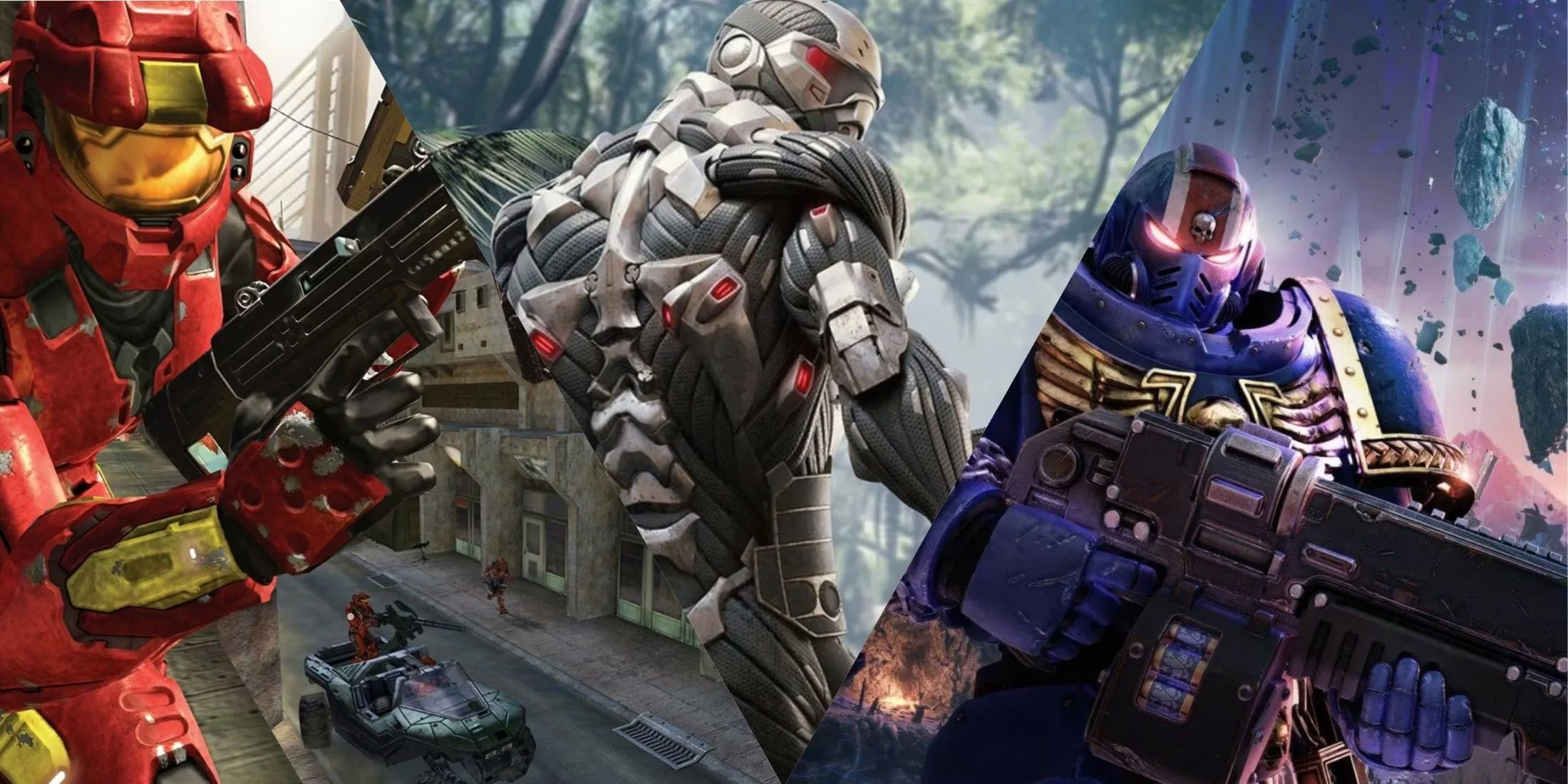
Power armor, as a concept, promised the impossible: turning a single soldier into a walking fortress. But the games Alex grew up with twisted that promise into something far more personal. In 2007, the world met Isaac Clarke, a simple engineer who survived horrors that would break most minds. His R.I.G. suit wasn't built for war—it was a tool of industry—yet it absorbed the tearing claws of Necromorphs and withstood the vacuum of space. Alex remembered the first time he clanked through the corridors of the Ishimura, the suit's health monitor beeping with every ghastly encounter. The R.I.G. wasn't heroic armor; it was a desperate lifeline, self-repairing variants becoming the only thing between Isaac and oblivion.
- 🔧 Dead Space R.I.G. – tool-turned-survival gear, vacuum-ready, with self-repair tech.
Then came Gordon Freeman's Hazardous EnVironment suit. To Alex, the HEV was science made tangible. A product of Black Mesa, that unmistakable orange armor wasn't just protection—it was a mobile laboratory. Its Geiger counter sang warnings of radiation while the integrated health monitor kept Gordon alive long enough to swing his iconic crowbar. Whether exploring the alien border world of Xen or fighting the Combine's grip on City 17, the HEV's ability to absorb impacts and track vitals turned a theoretical physicist into humanity’s last hope. The suit practically whispered, "Just one more test chamber…"
But not all power armor was subtle. The Confederate Marine Corps of StarCraft didn't just wear their suits—they were bolted and welded into them. Alex could still picture the cinematic intro: rows of hulking marines, their CMC armor so heavy they needed mechanical assistance just to stand. Inside those shells, ordinary humans traded comfort for the ability to duel Protoss zealots and Zerg swarms. Their suits amplified strength, integrated gauss rifle power supplies, and later added gravity generators for void combat. To Alex, this was the brutal logic of necessity—give a soldier enough metal and he becomes a siege engine, even if he can never take it off.
If the StarCraft marine was a siege engine, then the Fallout power armor was a walking tank that bridged the gap between infantry and armor battalion. Pre-war, it saw only limited action in Anchorage, but after the bombs, it became legend. The Western Brotherhood of Steel, though ultimately outnumbered by the New California Republic, fought with such tenacity that the armor itself seemed to multiply their numbers. Alex owned a tattered poster of a T-51b trooper standing amid nuclear fire, a reminder that sometimes protection wasn't just about winning—it was about enduring.
Then there were the suits that felt less like equipment and more like destiny. Samus Aran's Chozo-designed Power Suit was a biological marvel, fused to her very being. It could morph into a sphere, fire grappling hooks, and deploy bombs, all while resisting any attempt to remove it against her will. In Alex’s mind, Samus didn't wear the armor—she was the armor. Its ability to be summoned at will meant she was never truly unarmed, a terrifying thought for the Space Pirates who hunted her.
- 🌀 Metroid Power Suit – biological fusion, morph ball, summonable at will.
On the opposite end of the spectrum stood the Imperium of Man's creations. The standard Space Marine power armor, born in the Unification Wars, turned a post-human warrior into a sprinting fortress. Powered by a miniature nuclear reactor, it enhanced already monstrous strength to the point where a marine could outrun a car. Yet that was only the beginning. Terminator Plate, or Tactical Dreadnought Armor, was so durable it shrugged off everything short of dedicated anti-tank weaponry. Shield generators hummed within its bulk, and the ancient Cataphractii pattern remained a walking relic of the Horus Heresy. Alex imagined the deafening thud of those boots echoing through a starship corridor, a sound no heretic wanted to hear.
But for all their thunderous might, two suits defined the pinnacle of adaptability for Alex. The first was Master Chief's MJOLNIR armor in Halo. What made it revolutionary wasn't just the energy shield—reverse-engineered from Covenant Elites—but the intelligence woven into its fibers. Motion sensors, ballistic trajectory predictions, and structural integrity that let Spartans fall from orbit and keep fighting. The shield's regenerative hum became the heartbeat of an entire generation; as long as you could break line of sight, you could claw your way back from the brink. Chief and Noble Six turned that mechanic into an art, becoming the bane of the Covenant.
-
🛡️ Halo MJOLNIR – energy shields, AI integration, recharging survival.
-
⚡ Crysis Nanosuit – adaptive camouflage, superhuman strength, symbiotic immortality.
The second marvel was the Crysis Nanosuit. Reverse-engineered from Ceph technology, this sleek second skin could render a soldier translucent, amplify strength to flip vehicles, and—most unsettling of all—bond with its wearer's consciousness. The suit remembered. It carried the echoes of past operators, becoming a symbiotic entity that granted a terrifying form of functional immortality. Delta Force operatives, North Korean infiltrators, and C.E.L.L. mercenaries all sought its power, but Alex always wondered if the wearer ever really controlled the suit, or if the suit simply allowed them to believe they did.
Even the heroes of comic books got their digital power armor moments. In Marvel Rivals, Iron Man's suit might not have matched the sheer durability of Peni Parker's mech, but it compensated with dazzling agility. Lasers, flight, and a staggering array of repulsor tricks let Tony Stark dance around threats that would crush a less nimble combatant. It was a reminder that sometimes, the best defense wasn't armor thickness—it was never getting hit.
As Alex set the Fallout helmet back onto its stand, the 2026 evening light glinted off the visor. Real-world military exoskeletons were finally catching up, their developers openly citing the very games that lined his shelves. From the desperate survival of the R.I.G. to the godlike symbiosis of the Nanosuit, these digital armors had grown beyond fiction into a cultural blueprint. They whispered a question that had driven humanity for centuries: when the line between soldier and weapon blurs, what do we become? And somewhere, in the hum of his gaming rig, Alex knew the next chapter was already loading.
Comments