
Navigating the Shifting Sands: My Experience with Marvel Rivals' Fluid Rank System in 2026
Marvel Rivals' competitive ranking system and frequent rank resets create dynamic yet unpredictable matchmaking for hero shooter fans.
As I log into Marvel Rivals in 2026, the familiar buzz of a new season is in the air, yet it's accompanied by that peculiar feeling of starting over once again. The introduction of characters like Emma Frost in Season 2 was a blast, but the accompanying rank reset has become a predictable, if not entirely welcome, ritual. NetEase's approach to competitive ranking feels like trying to build a sandcastle right at the tide line—just as you think you've established something solid, a wave of reset comes and reshapes the entire landscape. This system, while refreshingly different from the often-stagnant ladders of other hero shooters, has created a world where the badge on my profile feels less like a medal of skill and more like a timestamp of my recent playtime.

The mechanics of the reset have been in a state of flux. I remember Season 1 dropping me about two and a half tiers. Now, as we're deep into the game's lifecycle, Season 2's reset was even more aggressive, pushing players a full three tiers down. One moment I was celebrating a hard-fought Grandmaster 3 finish; the next, I was blinking at a Gold 3 icon. This 'fresh start' philosophy is a double-edged sword. On one hand, it erases the grind fatigue and gives everyone a new mountain to climb. On the other, it completely scrambles the meaning of the ranks themselves. For the first few weeks, Gold isn't a tier of moderate skill; it's a chaotic melting pot where former elite players and dedicated climbers collide, making the matchmaking feel as unpredictable as a quantum particle's path.
This stands in stark contrast to the systems I've grown accustomed to in other games. The traditional MOBA-style ranked ladder, with its placement matches and subtle adjustments, acts like a geological stratum—layers settle over time, and players find a relatively stable level that represents their skill. It's precise but can feel immovable. Marvel Rivals throws that model out the window. Here, the ladder is less a measure of skill and more a treadmill of engagement. I've watched friends with sub-50% win rates steadily climb simply because they had the time to pour into the game. The system rewards persistence as much as, if not more than, pure prowess. This creates a bizarre dissonance: a Diamond rank at the season's dawn signifies a top-tier player, but that same Diamond rank six weeks later might just signify someone with a lot of free evenings.
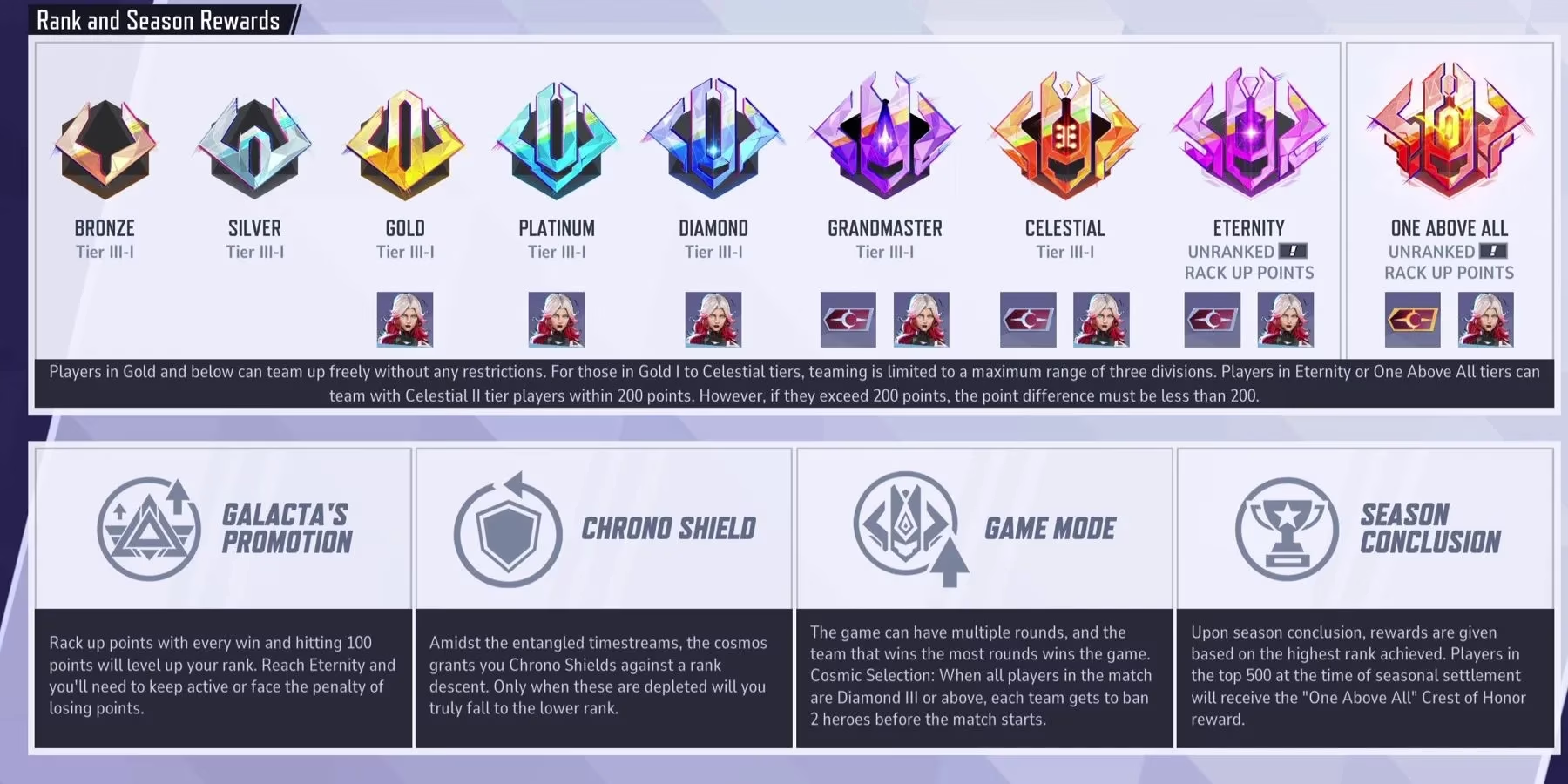
The consequence of this fluidity is matchmaking that often feels like a carnival game of chance rather than a competitive sport. You queue up, never knowing if your Gold-ranked teammate is a slumbering titan from last season's Grandmaster or someone genuinely learning the ropes. Games can be landslide victories or crushing defeats, with the tense, nail-bitingly close matches becoming a rare treat. The rank reset, intended to prevent stagnation, inadvertently creates a persistent state of chaos across all tiers until the very top. It's only when you breach the hallowed ground of Celestial, where a sub-50% win rate can no longer propel you forward, that ranks begin to solidify and truly mean something. Everywhere else, the label is provisional.
This means that in Marvel Rivals, I've had to learn a whole new language of contextualization. A Gold badge isn't simply 'average'; it's a question. When in the season is it? How many games has that player logged? I find myself doing more detective work than in other games, peeking at profiles (when they're not hidden) to gauge time invested versus win rate. It’s a system where a player who grinded 500 games to hit Grandmaster with a 48% win rate might be fundamentally less skilled than one who did it in 50 games from a similar starting point. The rank itself is an opaque veil, a bit like judging a book's complexity solely by its thickness.
NetEase has tinkered with the formula, of course. The mid-season reset discourse led to its abandonment, and there are whispers of performance-based algorithms tweaking the points gained or lost in each match, trying to add a skill-shaped counterweight to the time-based engine. But the core issue remains: the rank reset is the game's heartbeat, and with every pulse, the competitive ecosystem is flushed and restocked. Some days, I appreciate this. It saves me from the despair of being 'hard-stuck' in a single tier for months on end, a feeling I know all too well from other competitive titles. The constant motion, the ever-present goal of 'climbing back,' is a powerful hook. It turns the rank ladder into a perpetual journey, a Sisyphean task that somehow remains engaging.
Yet, the trade-off is a fundamental ambiguity. The ranks in Marvel Rivals require constant translation. They are not static landmarks but shifting weather patterns. You learn to read the season's meta, the population density of each tier, and the invisible clock that dictates a rank's current prestige. A Platinum player in week one is a force to be reckoned with; a Platinum player in week eight might be part of the crowded median. This system, for all its matchmaking woes, has fundamentally changed how I view competitive play. It's less about proving a static level of skill and more about demonstrating consistent adaptability and engagement over a rolling window of time. It's a grind, but it's a grind that's always in motion, never allowing you to rest on your laurels for long. In the end, whether this is a bug or a feature depends on whether you prefer the certainty of a stratified hierarchy or the exhilarating, frustrating chaos of the seasonal tide.
Comments