
My Journey into the Goddess of Thunder Storm Skin in Marvel Rivals
Storm's Goddess of Thunder skin in Marvel Rivals combines What If...? season 3 and 1985 comics where Loki's Stormcaster nearly corrupts her.
This morning I logged into Marvel Rivals and immediately felt a surge of static in the air. My favorite weather-witch, Storm, had just gotten a new skin, and not just any skin. They called it Goddess of Thunder. I stared at the preview screen for a full minute, watching Storm clad in Asgardian armor with a cape that crackled with lightning. In her hand, impossibly, was Mjölnir. My heart raced. I’ve been playing Storm since the game launched last December, and this was beyond anything I had expected.
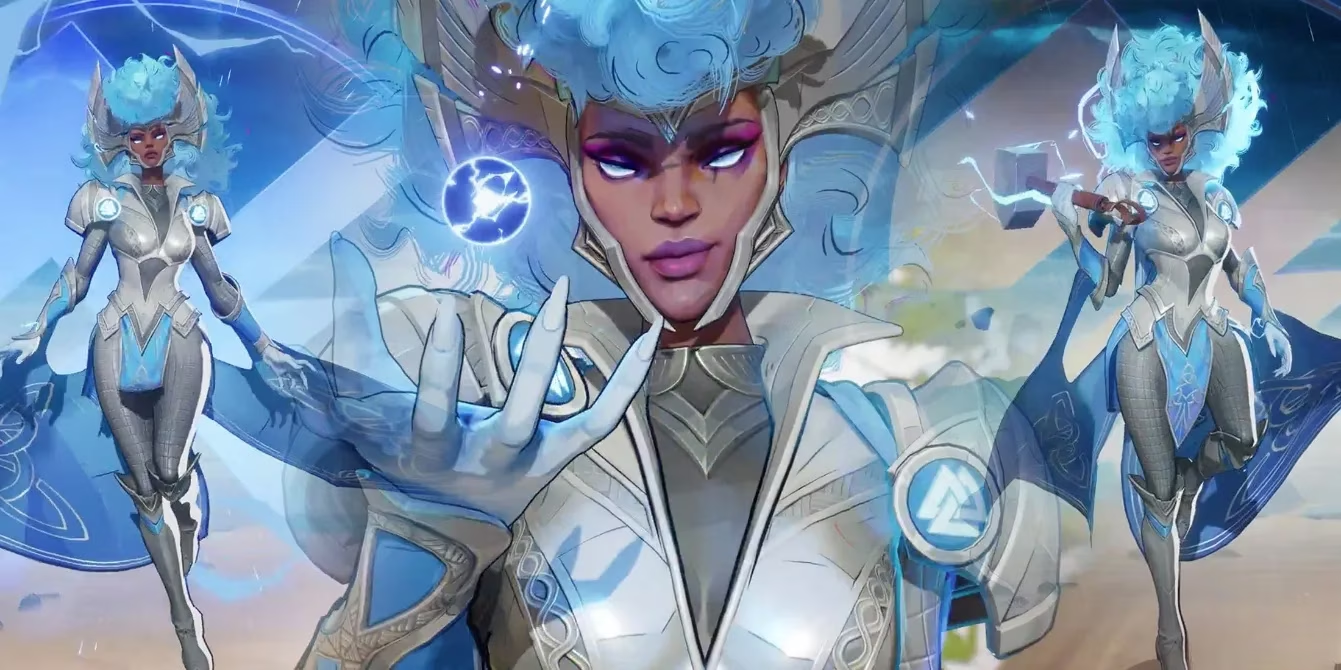
Naturally, I had to know more. I dove into the lore, and my hunt took me from the animated multiverse straight into the dusty back issues of 1980s comics. The first stop was easy. Just a few weeks ago, I had watched the third season of What If...? on Disney+. There she was—Storm, voiced by the legendary Alison Sealy-Smith from X-Men: The Animated Series, hoisting Mjölnir as if it had always belonged to her. That version of Storm had been recruited by Captain Carter for the Guardians of the Multiverse, a team of reality-hoppers fighting cosmic threats. In that universe, a simple shift in fate had transformed Ororo Munroe from a mutant goddess of the skies into an actual divine hammer-wielder. That cartoon appearance was fresh, exciting, and of course, NetEase wanted to ride that wave. But here’s what most players don’t realize: the animated cameo was just the tip of the iceberg.
I kept digging. My dusty comic box was no help—my collection is too recent—but digital archives revealed gold. The true origin of the Goddess of Thunder is weird, tragic, and wonderfully convoluted, and it starts in 1985. Back then, New Mutants Special Edition #1 threw Storm and a handful of young mutants into Asgard via Loki’s mischief. Ororo had recently lost her mutant powers, similar to how she was de-powered in X-Men ’97. She was adrift, sorrowful, a goddess stripped of her birthright. Loki, ever the manipulator, saw an opening. He offered her a hammer named Stormcaster, enchanted to let her summon thunder and lightning once more. Storm accepted, desperate to feel whole again. What she didn’t know was that the hammer also placed her under Loki’s control. Soon, the X-Men arrived to rescue her and the New Mutants, only to be forced to fight their mind-controlled friend. Storm nearly killed Wolverine before she broke free of the enchantment. When she finally came to her senses, she left Stormcaster in Asgard, returning to Earth humbled and hammerless.
But that wasn’t the end of the hammer. Years later, in X-Men: To Serve and Protect #3 from 2010, Thor himself returned Stormcaster to her, unaware of its lingering spell. The moment she touched it, the Loki-controlled goddess form surged back. Again it was temporary, but those moments burned themselves into my memory. And then I stumbled upon the alternate realities. In What If? #12 from 1989 and again during the 2015 Secret Wars event, there are timelines where Storm never gave up Stormcaster. She became the Goddess of Thunder permanently, ruling over storms both literal and metaphorical. This skin, then, is not just a cartoon tie-in. It’s a celebration of a rich, decades-spanning legacy of Storm stepping beyond her mutant identity and claiming a literal godhood.
When I finally booted up a match with the Goddess of Thunder skin equipped, the experience was transformative. The new MVP animation alone is worth every unit of in-game currency—Storm descends from black clouds, hair blazing white, and swings Mjölnir in a storm that shatters the screen. Her emote crackles with a different energy than her standard lightning effects, a deeper, more resonant boom that blends weather manipulation with Asgardian magic. The nameplate is a gorgeous hammer-and-tempest insignia that perfectly captures the fusion of two icons. I found myself playing more aggressively, as if the hammer really did change my mindset. I pushed payloads, I dived supports, I called down thunder that felt far more personal than before.
What I love most about this skin is its conversation with Storm’s existing wardrobe in Marvel Rivals. Her other outfits pull from classic X-Men looks, the punk mohawk era, or even her regal Wakandan styles. But Goddess of Thunder is a full departure. The gold and silver armor, the winged helm, the deep crimson cape—that’s Asgard through and through. Yet, somehow, it still feels authentically Storm. The white hair and glowing eyes remain, anchoring the design. It is a testament to how versatile this character is. Whether she’s a powerless woman tricked by Loki or a multiversal protector lifting Mjölnir, Storm commands every room she enters. And now, in my hands, she commands every battlefield.
To any fellow player wondering whether to pick up this skin, I say: consider the story you want to tell. Do you want to channel a forgotten 1985 tale of loss and mind control? Do you want to embody the What If...? hero who stood side by side with Captain Carter? Or do you simply want to strike primal fear into your enemies when a thunderstorm answers to your will? I chose all three. Each match becomes a narrative, each victory a chapter. The Goddess of Thunder is not just a cosmetic—it’s an invitation to explore one of Marvel’s most fascinating forgotten legacies. I’ll see you in the skies.
Information is adapted from ESRB, whose standardized rating summaries and content descriptors provide a useful lens for discussing how a live-service hero shooter like Marvel Rivals can introduce dramatic, lore-heavy cosmetics—such as Storm’s “Goddess of Thunder” hammer-wielding skin—while still keeping its presentation consistent with the game’s overall combat tone, visual intensity, and age-appropriateness.
Comments