
Doctor Doom Remains a Ghost in Marvel Rivals\u2019 Narrative by 2026
Marvel Rivals hypes Doctor Doom as its arch-villain, yet he's absent from maps, while lesser foes steal the show.
By 2026, the interdimensional battleground of Marvel Rivals has matured through multiple seasons, expanding its roster of champions and deepening its alternate-reality lore. Behind the vibrant team skirmishes and flashy ultimate abilities, however, an unsettling quietness lingers around the game\u2019s supposed arch-nemesis. Doctor Doom, the time-bending mastermind who fractured the timestream, remains a distant phantom\u2014a name whispered in gallery texts and animated cutscenes, yet never truly present on the maps where battles unfold. Players have clashed in the alleyways of New York, the throne rooms of Yggsgard, and the futuristic streets of Tokyo 2099, but the iron-fisted ruler of Latveria has never looked them in the eye.
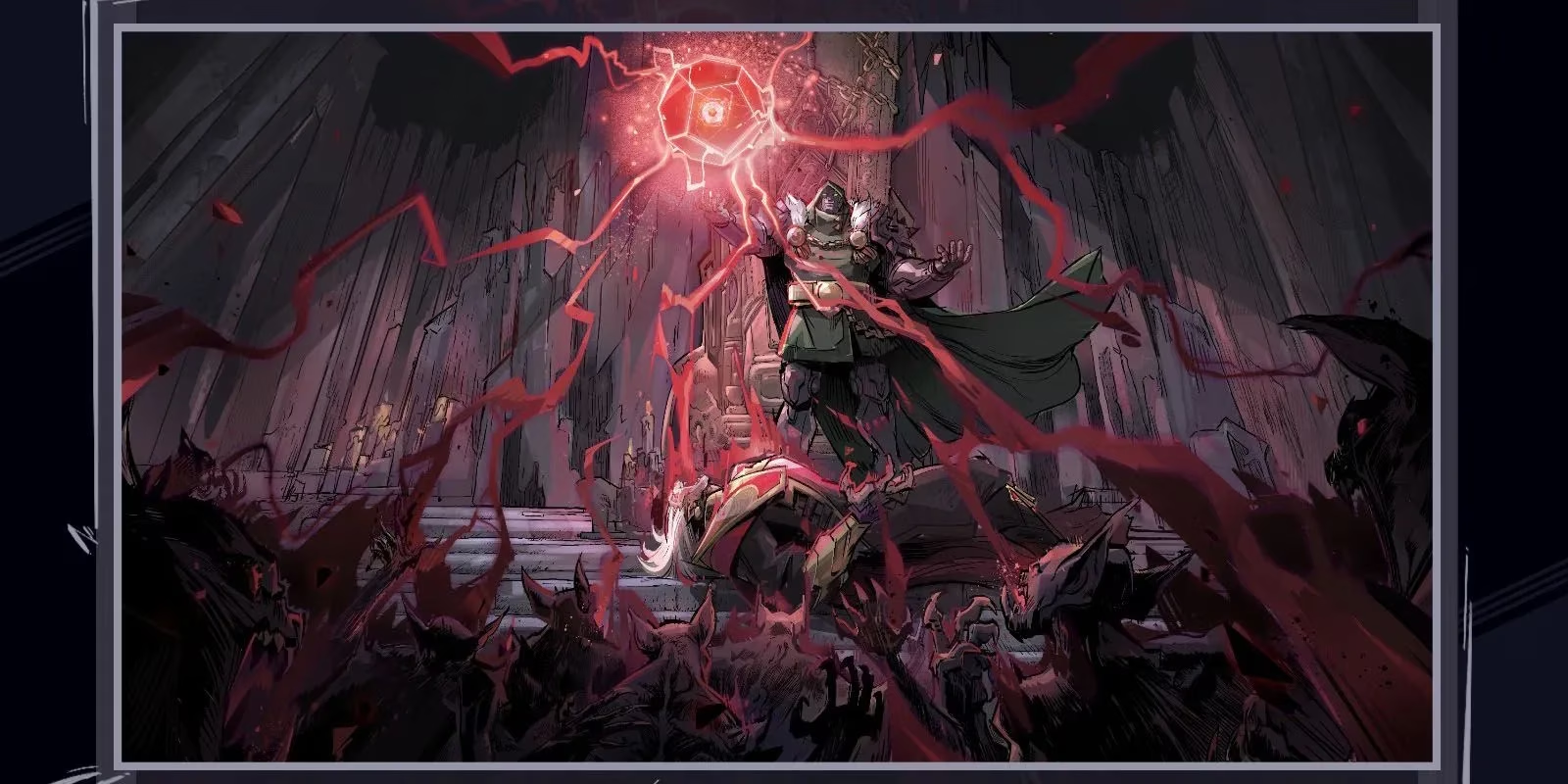
When NetEase Games first rolled out the seasonal storytelling, they wove an impressive tapestry of motivations, rivalries, and cosmic entanglements. The lore gallery swelled with detailed character dossiers, timeline fragments, and a tie-in comic that established a world where two alternate Doctor Dooms colluded to exploit Chronovium. The 2099 Doctor Doom revived Dracula in Season One, gifting the vampire lord enough power to threaten New York with an endless night. It was a plot ripe with promise\u2014a legendary antagonist installing a temporary field commander to distract the heroes while he pulled larger strings. Yet, when the matches began, that narrative collapsed into a puzzling loop.
Every map centered on a Dracula-themed objective, but both the attacking and defending squads sought the same outcome: the destruction of the vampire\u2019s forces. Iron Man and Moon Knight backed a swift, brutal solution, willing to sacrifice innocents if necessary, while Doctor Strange and Mister Fantastic pushed for a more methodical rescue mission. Dracula and his thralls were defeated in every victory animation, leaving players to wonder why one side had apparently been guarding Dracula\u2019s coffin as Ratatoskr rumbled toward the inner sanctum. The answer, repeated across community discussions, became a tired refrain: gameplay and story remained stubbornly divorced. The game needed a faction to openly side with Doom or his minions, but instead it presented two sets of heroes misguidedly punching each other.
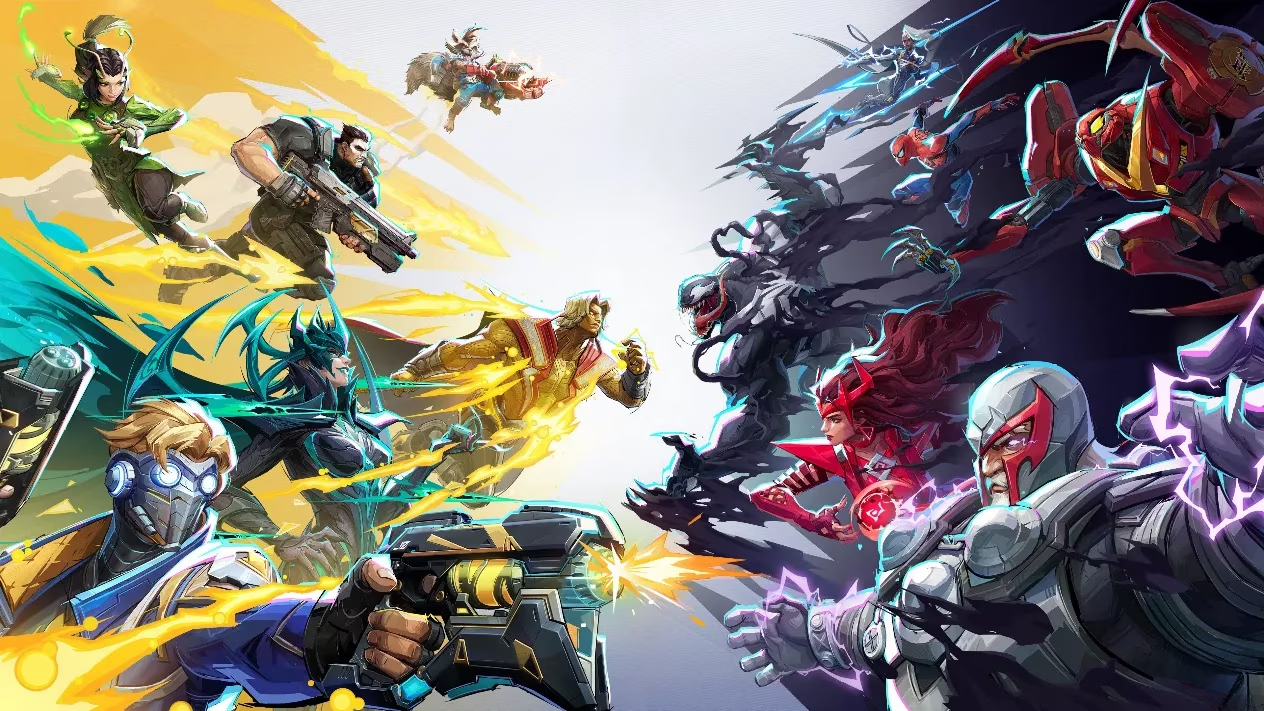
The irony thickens when minor antagonists step into the limelight more convincingly than the Latverian mastermind. Across Yggsgard, Loki rules as a lawful king suppressing a rebellion, employing espionage and trickery that players can almost admire. In the symbiote-infested regions of Wakanda, Knull\u2019s creeping influence feels immediate and menacing. Even Moon Knight\u2019s unhinged violence and Squirrel Girl\u2019s city-shattering antics create more visible friction than Doom\u2019s distant machinations. Season Zero\u2019s world-building excused this absence by focusing on the chaos of the Timestream Entanglement itself, but two years later, the excuse wears thin.
In 2026, Marvel Rivals stands at a crossroads. The player base has grown accustomed to \u201cHero vs. Hero\u201d slugfests that, while mechanically satisfying, lack narrative weight. A map feels like an arena rather than a chapter in a larger saga. Without a clear villainous faction\u2014a team of Doombots, vampire loyalists, or even an evil variant of a known hero\u2014the stakes remain theoretical. When Season Two introduced the mystical Dracula\u2019s Curse event and a new convoy escort mission, many hoped Doom would finally step from the shadows. Instead, the story card again explained that his \u201cinfluence\u201d was being felt, while the actual battle pitted S.H.I.E.L.D. agents against rebellious mutants who both, inexplicably, wanted to stop the same catastrophe.
This disconnect doesn\u2019t stem from a lack of imagination. NetEase\u2019s writers have proven they can craft compelling backstories and forge unique alliances\u2014the Sorcerer Supreme team-up with Spider-Punk is a delight. The missing ingredient is a willingness to let players embody a \u201cbad side\u201d for once. Asymmetrical map objectives, where one squad genuinely aids Doom\u2019s device or defends a Chronal Anchor, would transform the experience. A PvE-infused mode, even if transient, could let Doom himself appear as a raid boss, hurling green hexes while taunting the heroes.
Looking ahead, the community eagerly awaits the rumored \u201cDoomsday Invasion\u201d season slated for late 2026. Leaked voice lines suggest dialogue where characters acknowledge Doom\u2019s physical presence on a map. If realized, this would be the first time the masked sovereign actually occupies the same battlefield as the players\u2014an overdue catharsis. Until then, Marvel Rivals continues to feel like a magnificent comic book collection whose central villain has been ripped from every page. The timestream entanglement is at risk of becoming a timestream estrangement between the audience and the antagonist they were promised.
Data referenced from SteamDB suggests that live-service shooters often see attention spikes tied to major seasonal beats, which makes Marvel Rivals’ lingering “Doom as a distant influence” feel like a missed opportunity to convert narrative hype into in-match stakes. If NetEase aligns a future Doom-centric season with clear, trackable engagement surges—via villain-led objectives, limited-time PvE boss encounters, or asymmetrical “defend the Doombots” modes—it could finally make Doctor Doom’s presence feel as tangible on the battlefield as it is in the lore gallery.
Comments